


This article was adapted from the Portuguese original with the help of AI.
November is the time to prepare for the cold. If you live in Aichi, Gifu, Fukui, Gunma or Nagano, think about winter tires in Japan before the first frost. In this post you will see how to tell if your スタッドレス (sutaddoresu) is still good, what the law requires, and how to avoid fines and scares on the road.
Winter tires in Japan: what is a スタッドレス
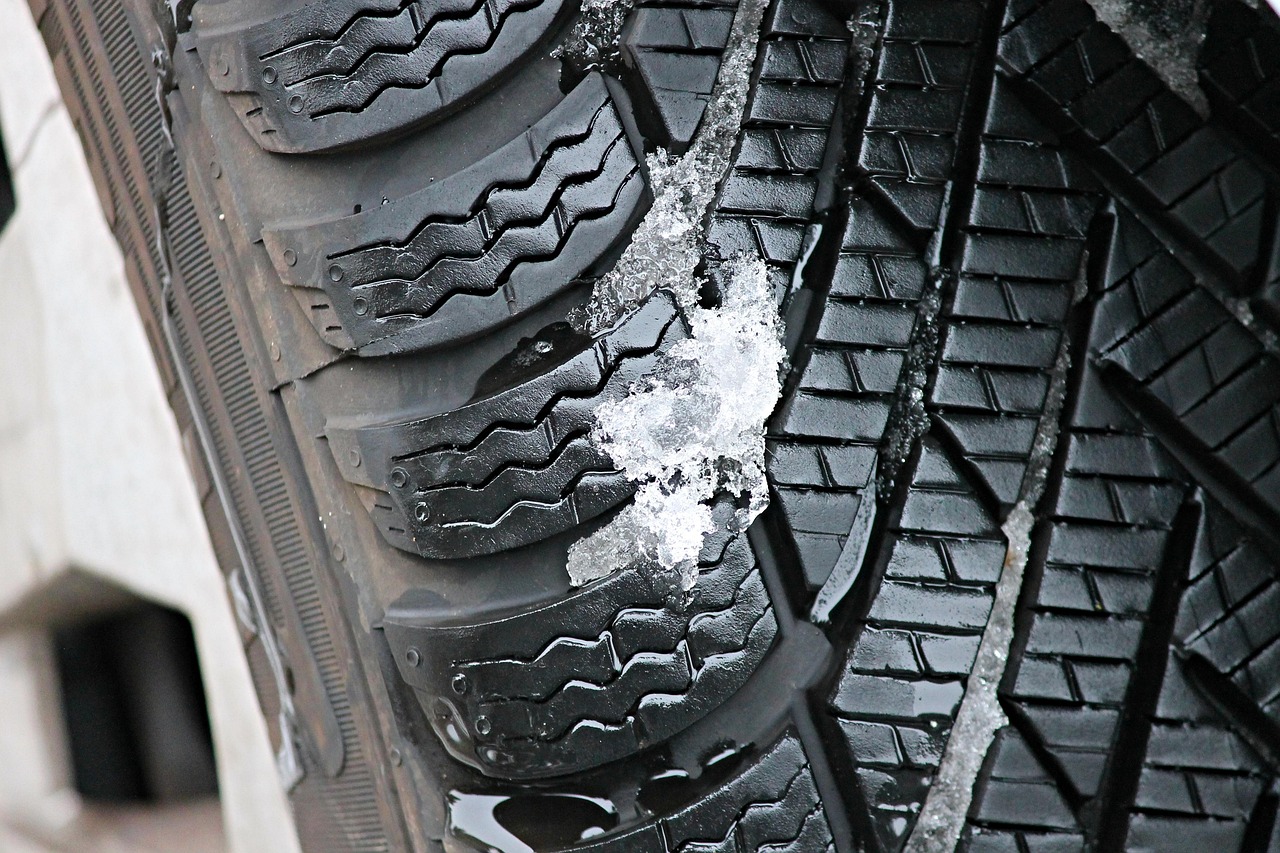
スタッドレスタイヤ (sutaddoresu taiya) is the winter tire sold in Japan. In Japanese, the general term is 冬タイヤ (fuyu taiya) or 冬用タイヤ (fuyuyō taiya). It is made to drive on snow and ice. A regular summer tire (ノーマルタイヤ, nōmaru taiya) is not.
Winter tires have a different usage limit than regular tires. So it is not enough to check whether there is still rubber left in the grooves.
How to tell if your winter tire is still good
プラットフォーム (puratto fōmu): the winter tire marker
The プラットフォーム is a marker inside the groove that shows how worn your スタッドレス is. It appears when the tire reaches about 50% wear. If it is showing, the tire has already passed its limit as a winter tire.
スリップサイン (surippu sain): the legal tire limit
A simple rule: the プラットフォーム marks the limit for a winter tire, and the スリップサイン marks the limit for the tire itself. When the スリップサイン is showing, the tire is finished for good.
| Marker | What it means |
|---|---|
| プラットフォーム | End of life as a winter tire (about 50% wear) |
| スリップサイン | End of life for the tire in general |
The 100-yen coin test
A new winter tire usually has grooves about 8 to 10 mm deep. A 100-yen coin can help with a quick check: the distance from the number “1” to the edge is about 5 mm. If you put the coin into the groove and you can still see the “1”, the wear is close to 50%.
This is a home test. When in doubt, ask a tire shop to measure it.
Age and rubber hardness
A good groove does not guarantee a good tire. The life of a スタッドレス depends on how deep the grooves are and how soft the rubber is. As a rough guide, if you have used the tire for 3 to 4 winter seasons, you can replace it without much hesitation.
Cracks and uneven wear are also signs that it is time to replace the tire. The tire shop or dealership can measure the hardness of the rubber.
What the law says about winter tires
Many people think the rule only applies on mountain roads. That is not quite right.
- Across Japan, except Okinawa, each prefecture’s rules require anti-skid protection on roads with snow or ice. That means winter tires or chains.
- If you break the rule, a regular car can receive a 反則金 (hansokukin, administrative fine) of 6,000 yen.
- If you do not pay the 反則金, you may have to pay a fine of up to 50,000 yen. This type of violation does not remove points from your driver’s license.
The rules vary a little from one prefecture to another. For example, Fukui’s rule only accepts winter tires whose contact surfaces are not worn 50% or more. In other words, a winter tire that is too worn may not count as protection. For the rule in your city, check the website of the 警察 (keisatsu, police) in your prefecture.
冬用タイヤ規制 and チェーン規制: they are not the same
There are two types of road controls. Knowing the signs will help you avoid being stopped.
冬用タイヤ規制 (fuyuyō taiya kisei)
Under this rule, only cars with winter tires or chains can pass. A 4×4 without winter tires or chains cannot pass either. Having four-wheel drive does not replace the right tires.
チェーン規制 (chēn kisei)
Since December 2018, some sections of highways have チェーン規制. Even with winter tires, you must have chains installed to pass. It applies to unusually heavy snowfall, on sections where cars have already been stuck in the snow. The chains can be metal, rubber or plastic, or fabric covers, as long as they are sold by an auto parts store. Buy them before winter and practice installing them at home, with the car parked.
Does an “all season” tire solve it?
It depends. The Ministry of Land, Infrastructure, Transport and Tourism (国土交通省, Kokudo Kōtsūshō) warns that all-season tires without the snowflake mark can also cause cars to get stuck and roads to be closed. If you are thinking about an all-season tire, ask the shop whether it has the snowflake mark. Also ask whether it meets the rule in your area.
Checklist before winter
- Check the プラットフォーム and do the 100-yen coin test.
- Look for cracks and uneven wear.
- Check how many years old the tire is.
- Book a tire change at the shop before the first snow forecast. In December, shops tend to get very busy.
- If you are going to the mountains, bring chains or a fabric cover in the trunk.
- Before you leave, check the forecast and traffic on official sites, such as the one from the 国土交通省 and JARTIC (日本道路交通情報センター, Nihon Dōro Kōtsū Jōhō Sentā).
Pay special attention to year-end trips, such as visits to Nagano, Gifu, Fukui or Hokuriku. Snow can catch those who only drive in Aichi or Shizuoka by surprise.
Frequently asked questions
I live in Aichi, where it hardly snows. Do I really need winter tires?
If you only drive on the flat lands and avoid days with snow or ice, you may not need winter tires all the time. But the rule applies to roads with snow or ice, and snow can appear without warning on mountain passes and higher areas. If you plan to travel to cold regions in winter, have your winter tires or chains ready.
Can a 4×4 drive without winter tires?
It is neither safe nor allowed to rely only on four-wheel drive. Under 冬用タイヤ規制, a 4×4 also needs winter tires or chains. On real snow, traction helps you get moving, but it does not help you stop.
Can I use last year’s winter tires?
Only if they are still within the limit. Check the プラットフォーム, the wear, the age and the condition of the rubber. If the プラットフォーム is showing, the tire no longer counts as a winter tire. When in doubt, ask the shop for an inspection.
Quick summary
- プラットフォーム showing: the winter tire is at the end of its life (about 50% wear).
- スリップサイン showing: the tire is beyond the legal limit.
- Across Japan, except Okinawa, you need winter tires or chains on roads with snow or ice. The 反則金 is 6,000 yen for a regular car.
- In Fukui, the rule refers to winter tires with less than 50% wear.
- Under チェーン規制, even a スタッドレス needs chains.
- Replace or inspect your tires before winter, and confirm the rules with the police in your prefecture.
Sources
- 冬道走行とタイヤ (日本自動車タイヤ協会)
- 冬期の安全運転は、ドライバーの皆さんの心がけが大切です (国土交通省 中部地方整備局)
- 冬のタイヤの滑り止めルールって? (タイヤ公正取引協議会)
- 冬の高速道路をご利用する際のお願い (日本高速道路保有・債務返済機構)
- 大雪に関するお願い (国土交通省 関東地方整備局ほか, 2025年12月)
Cover image: manfredrichter / Pixabay
Note: This article is for information only. Rules and amounts may change, and coverage, conditions and claim payments depend on each policy. Please confirm with your insurer.
World Insurance — Okazaki (Aichi) and Fukui. Contact World Insurance
Leave a Reply